
Sue Equifax
Sue Equifax for Credit Report Errors
You disputed the error. Equifax "verified" it anyway. That's not the end — it may be a violation of federal law. Our FCRA attorneys sue Equifax to force the correction and recover damages for the harm it caused. No fee unless we win.
Can You Sue Equifax?
Yes. Under the Fair Credit Reporting Act (FCRA), you can sue Equifax in federal court when it fails to conduct a reasonable investigation of your dispute, or keeps reporting information you've shown is inaccurate. You generally must dispute the error first and give Equifax the chance to fix it — if it verifies the false information or ignores you, that failure is what creates your claim.
Most people never realize how strongly the law is on their side. Equifax is a multi-billion-dollar company, but the FCRA lets an ordinary consumer hold it accountable — and shifts your attorney fees onto Equifax when you win.
Top Reasons People Sue Equifax
Failure to investigate — You disputed an error and Equifax ran an automated check, "verified" the false data, and closed it without a real investigation.
Mixed credit file — Equifax merged someone else's accounts, debts, or identity into your report because of a similar name or SSN.
Reported as deceased — Equifax flagged you as deceased, freezing you out of credit, loans, and accounts.
Reinserted errors — Equifax deleted an error, then let it reappear without notifying you — itself an FCRA violation.
Identity theft accounts — Equifax keeps reporting fraudulent accounts even after you filed an FTC identity theft report.
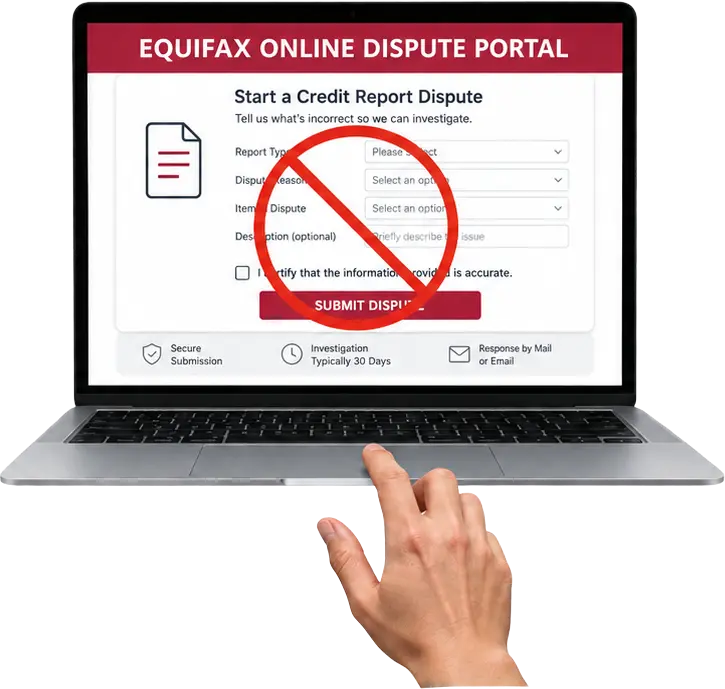
Before You Dispute: Don't Use Equifax's Online Portal ⚠️
⚠️ Important insider tip: Equifax's online dispute portal often includes an arbitration agreement buried in its terms of service. Clicking "agree" can waive your right to sue Equifax in court. If your error is serious — identity theft, accounts that aren't yours, debts reported after bankruptcy — do not dispute online. Dispute by certified mail instead, so you keep your right to a federal lawsuit and have proof of what you sent and when.
How to Sue Equifax for a Credit Report Error

Dispute in writing
Send Equifax a certified-mail dispute with copies of your evidence. This starts the FCRA's 30-day investigation clock and creates your paper trail.

Wait for the response
Equifax generally has 30 days to investigate and respond in writing. If it corrects the error, great. If it "verifies" the false information, you may have a claim.

Bring in an attorney
We review your dispute, the response, and the harm caused, and build an evidence-based case Equifax can't brush aside.

File suit in federal court
If Equifax still won't fix it, we sue under the FCRA to force the correction and recover your damages and attorney fees.
About Equifax
Equifax is best known for its 2017 data breach, which exposed the personal information of roughly 147 million Americans. It remains one of the most-sued credit bureaus for failure to investigate disputes and for mixed-file and identity-theft reporting.
Dispute contact details (for reference — we handle this for our clients):
• Headquarters — Atlanta, Georgia
• Dispute by mail — Equifax Information Services LLC, P.O. Box 740256, Atlanta, GA 30374-0256
• Phone — 1-888-378-4329 (1-888-EQUIFAX)
PARTNERS
Who We Work With






Client Success Stories
Jose helped me go through my credit report and immediately spotted signs of identity theft. He explained everything clearly and walked me through the next steps. The whole process was quick and smooth.

Excellent law firm. They fought hard for me when an identity theft account was reporting on my credit report. Best law firm in New York.
My mother had her identity stolen and debt collectors kept coming after her. Tariq Law researched the fraudulent activity, stopped wage garnishment, and got her money back.
I contacted them after receiving a summons related to a credit complaint. They explained my options and helped me file a motion to dismiss. The case was dismissed.
had a great experience with Tariq Law. They solved my issues quickly and efficiently. Carlos was very responsive and genuinely caring
These guys are extremely professional and knowledgeable. They truly care about helping people. I even came back a second time.
Frequently Asked Questions
Q1. Can I really sue Equifax as one person against a huge company?
Yes. The FCRA was written to let individual consumers hold the credit bureaus accountable. You don't need to match Equifax's resources — the law shifts your attorney fees onto Equifax when you win, so you can pursue a strong case with no money out of pocket.
Q2. Do I have to dispute with Equifax before I can sue?
In almost all cases, yes. Courts generally require you to give Equifax notice of the error and a chance to fix it through the dispute process first. When Equifax then fails to investigate reasonably or verifies the error anyway, that failure is what gives you the right to sue.
Q3. How long do I have to sue Equifax?
The FCRA generally gives you two years from the date you discovered the violation, or five years from when it occurred — whichever comes first. Because deadlines vary by situation, it's best to have your case reviewed as soon as you realize Equifax won't fix the error.
Q4. How much does it cost to sue Equifax?
For most cases, nothing upfront. We work on contingency, and the FCRA's fee-shifting provision means Equifax pays your attorney fees when you win. Your case review is always free.
Q5. What will I get if I win?
It depends on the harm. You may recover actual damages (denied credit, lost opportunities, emotional distress), statutory damages of $100 to $1,000 for willful violations, and in some cases punitive damages — plus the correction of your credit report itself.
Ready to Hold Equifax Accountable?
Every month a Equifax error stays on your report, it can cost you more. Find out whether you have a case — it's free, and you pay nothing unless we win.

We also help consumers sue the other two bureaus — Experian and TransUnion."

Defending your rights against inaccurate credit reporting and identity errors under the Fair Credit Reporting Act.


Subscribe to our newsletter
© Copyright 2026. Credit Report Lawyers. All rights reserved.